Most ottoman buying guides start with shape. We think that's the wrong starting point. After two years of designing, shipping, and occasionally taking back ottomans in our Bhilwara workshop, the two decisions that decide whether a customer keeps the piece are made before the box is ever opened: the height was wrong for their sofa, or they paid extra for storage they were never going to use.
Get those two right and almost everything else — round vs rectangular, leather vs fabric, print vs solid — becomes a matter of taste rather than regret. So this piece is a framework, not a catalogue. It applies to any ottoman from any brand. We'll point to our own pieces where they illustrate a principle, but the goal is for you to close this tab with a sharper mental model for picking the right one, even if you end up buying somewhere else.
Height first, everything else second — and Indian sofas change the math
The default ottoman height on most Indian e-commerce listings is 18 inches. That number is borrowed from American living rooms, where the standard sofa seat sits around 18–19". An 18" ottoman in front of an 18" sofa works — your feet rest, your knees stay roughly level with your hips, a thrown blanket distributes its weight properly.
Indian sofas, in our experience designing for them, tend to sit lower. The mainstream range we keep seeing is closer to 15–17". Imported European and some Italian lines push 17–18". The lower-slung teak sofas common in Kerala and parts of the south can drop to 14–15". Put an 18" ottoman in front of a 16" sofa and your knees ride two inches above your hips — fine for ten minutes, painful by week three, abandoned by month three.
The rule we'd give a friend:
- Measure compressed, not unloaded. Have someone sit on the sofa. Measure floor to top-of-cushion under their weight — cushions sink an inch or more, and that inch is the whole game.
- Subtract one inch. That's your ottoman target, with about an inch of tolerance either way.
- For most Indian living rooms, you want 15–16.5". Anything taller is almost always a mistake, however good the photograph looks.
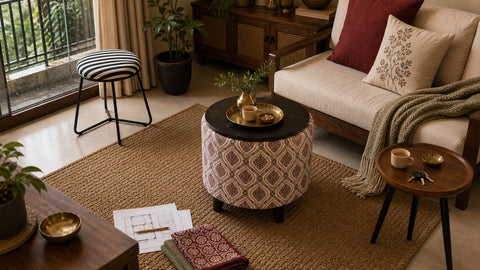
Our printed wooden footstool sits at the lower end of that window for a reason — not because we picked the height for visual appeal, but because it's the band where the most sofas in this country actually live.
The storage question isn't "do I need storage" — it's "how often will I lift the lid"
Every ottoman article on the internet asks whether you need storage. We think that's the wrong question, because almost everybody answers yes — storage sounds free. It isn't. A storage ottoman costs roughly 60–80% more than the equivalent non-storage version, because you're paying for a sturdy hinged lid, a reinforced frame that won't sag when the lid is closed, and a hollow base that has to keep its shape under load.
The better question is: how often will you actually open it?
Storage ottomans that get opened weekly — for nightly blankets, kids' toys, the cricket gear after Sunday matches — they earn their price. Storage ottomans that get opened once a quarter — for festival tableware, winter quilts, the trekking backpack — also earn their price, because the storage shows up exactly when it's needed. The case that doesn't work is the in-between one: bought for "extra storage someday," used as a footrest, lid never lifted. Six months in, the customer has paid a premium for a hinge they don't touch.
So the honest split:
- Buy storage if you can name three specific things you'll put inside before checkout. "Blankets, board games, and shawls" is a valid list. "Just in case" is not.
- Skip storage if the ottoman is going in front of a sofa where you'll prop feet, balance a tray, and let the dog claim it. The hinge becomes an annoyance you'll route around.
If you've worked through that and you're on the storage side, this is the one we'd point you to:
We chose a piano-style hinge that runs the full length of the lid rather than the cheaper two-barrel-hinge approach you'll see at this price point. The reason is mundane and important: when you open it one-handed with a stack of blankets in the other, a full-length hinge doesn't wobble. The two-barrel design sags within a year. We learned that on a prototype run early on and never went back.
Round photographs better, rectangle lives better
Scroll any furniture brand's Instagram and you'll see round tuffets everywhere — the curve softens the straight lines of a sofa, the print wraps elegantly around the form, the shadow falls gently. We sell plenty of round pieces ourselves, and our cherry red mandala tuffet is one of the most-photographed pieces we make.
But photography is not the same as use. In a real Indian living room — particularly the 1BHK and 2BHK formats most of our customers actually live in — the rectangular ottoman wins the year, for three reasons:
- You can balance a tray on a rectangle — chai, snacks, a laptop. You cannot, reliably, on a round.
- You can seat two guests on a rectangle during a weekend visit. The round one fits one.
- The rectangle pushes flush to a wall when you need the floor open for festival seating or a yoga mat. The round one wastes the corner.
The way we'd phrase the choice: if the room is dedicated to display — controlled shelves, art on the walls, a household of one or two — go round. The visual softness matters more than the function. If the room hosts meals, guests, and the joint-family shapeshift on weekends, go rectangular. Most Indian living rooms are the second kind, even when we wish they were the first.
Leather vs fabric: the answer is mostly about dust
Leather looks premium. Fabric looks warm. Most buying guides leave it there. The actual deciding factor for households across most Indian cities is far more boring: dust.
If you live near construction, near a main road, or in any of the metros where particulate levels regularly cross 100 µg/m³ — much of Delhi NCR, parts of Mumbai outside the south, Bangalore in the dry months, Pune, Hyderabad, Ahmedabad, most tier-2 cities — fabric ottomans need a vacuum-and-lint-roll every couple of weeks to keep looking like themselves, and a deeper clean once a year. Printed fabrics hide more than plain ones do, which is one reason our printed pieces tend to outsell plain ones, but the maintenance is still real.
Leather is, frankly, the lazy option — and we don't mean that pejoratively. A damp microfibre cloth wipes it down in thirty seconds. Our grey leather tuffet is what we'd recommend for households with young kids, pets, or anyone honest enough to admit they won't vacuum a fabric piece every weekend.
One caveat: monsoon-coastal cities. In a Mumbai, Goa, or Kerala home running 80%+ humidity for four months, leather pieces parked against an outside wall can mildew along the seams. The fix is to pull the piece a few inches off the wall during July–September, or to pick fabric and accept the vacuum routine.
Placement is half the decision people forget to make
People shop for ottomans the way they shop for chairs — as an object, in isolation. But an ottoman lives or dies on placement, and placement is where the size of your home actually matters.
In a 1BHK, the ottoman will almost certainly pull triple duty: footrest in the evening, side-table when the dining table is occupied, extra seat when someone drops in. The piece you want has a flat firm top (not deeply tufted, which can't take a tray), a 15–16" height, and enough lightness to move with one hand. Keep it within arm's reach of the sofa so you're not lifting it across the room every time the use shifts.
In a 2BHK, you have room for a dedicated ottoman in front of the sofa and a second smaller tuffet as a floating accent — by a reading chair, at the foot of the bed, in the pooja corner as a low altar seat. We've watched the cherry red mandala end up as a pooja-room stool more often than we expected. It wasn't designed for it, but the 14" height happens to be right and the mandala reads as devotional in context.
If the constraint is square footage rather than count, we go deeper on that puzzle in our Mumbai apartments piece, and our small-living-room styling notes cover how to anchor a room around a single piece without crowding it.
A note on price, since nobody else says this out loud
Ottomans in India run from about ₹1,200 (mass-market, MDF base, stapled upholstery) to ₹15,000+ (designer, solid wood, hand-stitched). Our range sits between ₹1,999 and ₹4,500. We think that's the honest band for a piece you'll use daily for five-plus years.
Below ₹1,500, the base is usually engineered board that swells in monsoon — the lid stops closing flush by year two. Above ₹6,000, you're often paying for showroom rent and brand mark-up rather than craft, unless the piece is genuinely solid hardwood or hand-carved (most aren't; verify the spec, not the listing copy).
The cost behind a Greetwood ottoman is mostly hand labour — the same workshop economics we wrote about in our piece on Indian metalwork from Bhilwara. Same workshop, same upholstery families, same insistence that the cushion is hand-stitched rather than machine-overlocked. The trade-offs are identical: you're paying for slower hands and tighter quality control, not for a brand.
The three-minute test before you buy anything
Before clicking checkout on any ottoman — ours or someone else's — run these three checks:
- Sofa-seat height, compressed. Sit on the sofa. Measure floor to top-of-cushion. Subtract one inch. That's your target, with an inch of tolerance either way.
- Lid test (storage only). Name three specific things you'll keep inside. If you can't, buy the non-storage version and save the premium.
- Dust honesty check. Will you actually vacuum a fabric piece every couple of weeks? If no, go leather, or at least go printed-and-forgiving rather than plain-and-pale.
The ottoman is the most quietly useful piece of furniture in a home. It earns its place by getting out of the way until it's needed — for your feet, for a tea tray, for a guest's coat, for last winter's quilts, for a child colouring on the floor. Pick the height right, be honest about the lid, and the piece will do the rest.