If you live in an Indian metro and your living room is under 150 sq ft, almost every piece of small-space advice you'll read online is wrong for your home. Not maliciously wrong — just imported. The breezy listicles about light palettes, mirrors, and "less is more" were written for a household that hosts two people on a Tuesday. Yours hosts four on a Tuesday, seven on a Saturday, and a small crowd during Diwali — plus the chai tray, plus winter razais that have nowhere else to live from June to September.
This is our argument for how to actually furnish a small Indian living room with artisan furniture, written for someone mid-decision and tired of the generic version.
The contrarian bit: a small Indian living room doesn't need less furniture — it needs denser furniture
The dominant Western advice on small spaces is some flavour of minimalism: fewer pieces, lighter palette, more negative space, let the room "breathe." It is sensible if your living room is asked to host two people. It is unhelpful for an Indian urban household, where the same square footage is asked to do roughly four different jobs across one week.
Subtracting furniture from a 130 sq ft living room doesn't make it feel bigger. It just makes everyone sit on the floor and stack the blankets on the one chair you've already decided to throw out. What works, in our view, is the opposite: fewer large pieces, more small, mobile, storage-carrying pieces that disappear when not in use and multiply when they are. Density done well reads as airy; density done badly reads as clutter. The whole craft of furnishing a small Indian flat is knowing the difference.
Most customers we hear from in Mumbai have already made the minimalism mistake once — a low-slung two-seater, a single coffee table, called it done, and then the room collapses the first time a cousin visits. We'd rather you skip that detour.
Rule 1: One piece should do at least three jobs (and we mean three real jobs)
"Multi-functional furniture" is the rule everyone repeats and almost nobody follows. In most blog posts it means a sofa-cum-bed, which is technically two jobs but so awkward at being either that you end up resenting both.
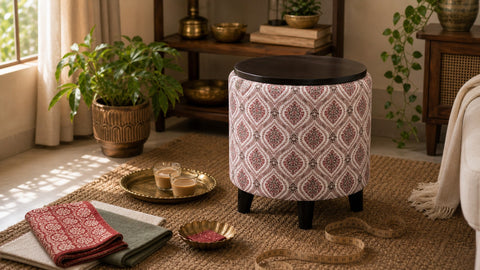
The test we'd use: name three distinct, weekly jobs the piece will do in your specific home. If you can't, it's a single-function piece pretending. The piece in our range that consistently passes this test is the storage ottoman — small enough to live in front of a two-seater sofa, soft enough to sit on, hollow enough to swallow the razais.
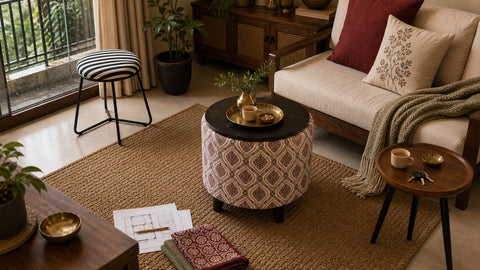
On a normal week it's doing: coffee table for chai and a laptop, extra seat when someone visits, and storage for the heavy razais that used to live on top of the wardrobe. When you have people over for dinner it becomes the dessert station — job four, unplanned. One piece, no drilling.
The dimension that matters here, and that almost no one talks about: a storage ottoman that's going to double as a coffee table needs to sit roughly level with the front edge of your sofa cushion. Most "storage ottomans" sold online in India are spec'd to European sofa heights, which tend to run taller than Indian ones. We design ours lower for that reason. Measure your sofa-seat height before you buy any ottoman online.
Rule 2: Buy vertical accents you can lift with one hand
The second piece of advice every small-space article gives is "use vertical accents to draw the eye up." Correct in principle, hopeless in execution, because the pieces they recommend are usually tall floor lamps or bookshelves that, once placed, never move again. In a small flat, every piece of furniture you can't lift with one hand is a piece you'll resent within six months.
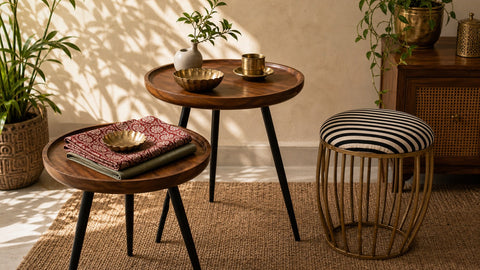
What we'd recommend instead is a pair of light, single metal stools you can pick up and move as the room's job changes — perch for a cup beside the sofa on Tuesday, plant stand by the balcony on Wednesday, extra dining seat on Saturday. Our Cage stool is designed to that brief. The compact matt-black variant is the same idea in a quieter finish — slips into a darker palette without announcing itself.
The reason metal earns its place in a small Indian living room more than wood at this size is humidity. A wooden stool in monsoon-belt humidity moves at the joints over a few years. A well-finished powder-coated steel frame doesn't. We use both materials deliberately, and we wrote about which to choose where in our piece on mixing metals and wood at home.
Rule 3: The floor is furniture — and your tuffet is the bridge to it
Festival floor seating is something Western design language has almost no vocabulary for. Diwali, Ganesh Chaturthi, Eid lunches, a casual puja on a weekday morning — half the year, the most important part of an Indian living room is the floor itself. The room needs to convert.
The piece that makes that conversion painless is a low tuffet — low enough to lean against from the floor, soft enough to sit on for an hour, light enough to push to a corner when not in use. Our Mandala wooden tuffet is built on a mango-wood base with a hand-stitched cotton top. At ₹1,999 it's the cheapest piece in our range, and it's also the one we'd most strongly recommend buying in a pair.
The reason is structural, not decorative. When several people sit on the floor for a puja, two tuffets at the back of the group become back-rests for the elders; the floor in front of them becomes seating for everyone else. Tuffets convert a flat surface into a tiered one. One tuffet is a knick-knack. Two tuffets are infrastructure.
Rule 4: Resist the all-beige room — warmth comes from one strong colour, not from none
"Light colours make a room feel bigger" is the most overused tip in small-space writing, and it's only half true. Light walls make a room feel bigger. Light furniture in a light room makes the room feel like a dentist's waiting area.
The pattern that consistently works is: cream or off-white walls, one piece in a strong terracotta, maroon, or cherry-red, and everything else in calm neutrals. The single saturated piece does two jobs at once — it anchors the room visually so the eye has somewhere to land, and it absorbs the room's "warmth budget" so the rest of the furniture can stay quiet. If your sofa is oatmeal and your walls are bone-white, that anchor is the job the ottoman or the tuffet should be hired for.
Customers who try to spread the colour across four pieces — a coral cushion, a mustard throw, a green planter, a printed rug — usually end up with a room that reads busier than if they'd picked one bold piece and left the rest alone. Colour, like density, works better concentrated than distributed.
Rule 5: Leave one square metre completely empty — and defend it
The most underrated rule of small-space living, and the one we end up repeating to almost every customer: pick one square metre of your living-room floor and commit to keeping it empty. Not "mostly clear." Empty. No side table, no plant, no laundry basket, no Amazon box "for now."
That one empty square metre is what makes the rest of the room work. It's where the floor seating goes during a festival, where you do surya namaskar at 6 a.m., where a guest puts their suitcase, where a toddler crashes a toy car. Without it, the room loses the ability to reconfigure — and a room that can't reconfigure is a room that fights you every weekend.
Showrooms have no Diwali. Your living room does. If you're choosing between a fourth piece of furniture and a permanent empty square, choose the square.
So what should a small Indian living room actually contain?
Our default recipe for a 100–140 sq ft living room with a two-seater sofa already in place:
- One printed storage ottoman, used as coffee table and razai store. The colour-anchor piece for the room.
- A pair of single metal stools — light enough to move daily, finished well enough to survive monsoon humidity.
- A pair of low tuffets — for festival floor seating, kept against a wall otherwise.
- One small side table beside the sofa arm for the evening chai cup that doesn't fit on the ottoman. Our walnut side table is sized for this slot.
- One empty square metre of floor. Non-negotiable.
That's five pieces, not three, and not seven. None of them is "less is more." All of them are doing at least two jobs.
If you want the longer version of this playbook with room-by-room measurements, we wrote it up in our space-saving furniture guide for Mumbai apartments. If the question on your mind is specifically about the metal pieces — why they last, what to ask before buying — we covered it in our piece on Indian metalwork from workshop to home.
The short version is this. A small Indian living room is not a space problem. It is a density problem. Solve for density, with pieces that earn their footprint three jobs at a time, and the space takes care of itself.