If you're furnishing a Mumbai apartment — yours or someone else's — there's a question worth asking before you buy a single piece: not how do I make it look bigger, but what does each piece have to do? Most small-space advice answers the first question. We think the second one is what actually decides whether the home works a year in.
This is our argument for treating a Mumbai 1BHK as a design constraint problem, not a styling problem. It's written for someone about to commit to four or five furniture pieces they'll live with for the next five years, in a flat that almost certainly has less usable floor than the listing suggested.
Why the square-footage number is the wrong starting point
Mumbai 1BHKs typically advertise between 400 and 600 sq ft of carpet area. That number gets quoted in every brokerage listing and most furniture blogs. It's also misleading, because the figure that constrains your furniture isn't carpet area — it's usable floor after circulation. Subtract the door swings, the kitchen counter zone, the path to the bathroom, the clearance for the bedroom door, and the realistic standing room near the entrance, and the number shrinks by roughly a third.
This matters because the planning logic is different once you account for it. A 2-seater sofa that "fits" in a showroom takes up a meaningful slice of usable area in a typical Andheri or Mulund 1BHK. A nesting coffee table sounds clever until you notice the smaller nested piece has nowhere to retreat to when it's not in use. The constraint isn't the room size on paper. It's the absence of slack in the room you actually live in.
Our rule of thumb when we plan furniture for compact Indian flats: every piece should earn its footprint by doing two things, not one. A sofa is allowed to just be a sofa because there's no realistic alternative. Everything else has to multitask.
The contrarian bit: portable furniture is overrated
Most small-space advice will tell you to go light and portable — pieces you can shove against a wall when relatives visit, drag onto the balcony for chai, carry from living room to bedroom. We'd push back on this. We think portability sounds like flexibility and usually delivers friction.
You don't actually move the side table to the balcony for chai — you carry the chai to wherever the table already is. You don't drag the stool into the bedroom; the stool stays where it last got used and slowly becomes the place you dump laundry. The Mumbai apartment doesn't reward flexibility — it rewards permanence with multiple uses. A piece that does three things from one location beats three pieces that each do one thing from many locations, almost every time we've watched it play out.
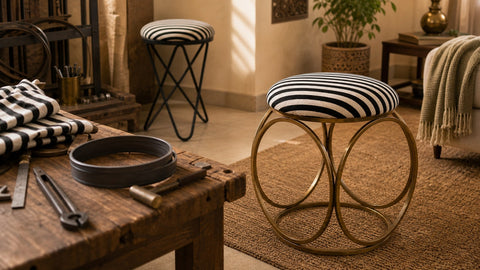
The one exception is overflow seating for festival hosting or weekend joint-family visits. If you regularly have eight people in a flat sized for four, you do want stack-able auxiliary seating — and our compact matt-black metal stool is built for exactly that job. But that's an overflow piece, not a daily piece. The daily setup should be heavier, anchored, and quietly doing four things at once.
The one piece that earns its footprint twice over: the storage ottoman
If we had to recommend a single piece to anyone furnishing a Mumbai 1BHK from scratch, it would be a rectangular storage ottoman placed where most people would put a coffee table. This is the pattern we hear most often from Mumbai customers — the ottoman ends up being the most-used object in the room, by a wide margin.
The case for it, in a sentence: a Mumbai 1BHK has nowhere to put winter quilts, festival décor, the suitcase of "we'll need this later," and the trailing flotsam of monsoon — rain jackets, the spare umbrella, the bedsheets that come out in July. A coffee table holds none of that. A storage ottoman holds all of it, then doubles as a footrest, as overflow seating when six friends squeeze onto a four-person sofa, and — with a tray on top — the coffee table you thought you were going to buy anyway.
A few things worth knowing about ottomans specifically in a Mumbai context. Darker, patterned colourways hide chai stains and the inevitable monsoon water-mark better than the pale neutrals most "small-space" guides recommend — the design logic flips when you account for humidity and how often a single piece will get sat on, eaten off, and used as a side table by guests. Height matters more than people think: an ottoman that sits flush with the cushion line of your sofa works as a footrest; one that sits an inch too high makes your knees cramp. And in a flat where lift dimensions might constrain delivery, a piece you can carry up a stairwell on a single person's shoulder is materially more useful than one that requires two people and a negotiation with the society secretary. We wrote about ottoman sizing in more detail in our ottoman guide if this is the decision you're actually trying to make.
Tuffets and the floor-seating problem
Indian living rooms tend to host more people than they were sized for. A four-person sofa is genuinely a four-person sofa for maybe two months of the year; the rest of the time it's seating five or six because someone's sister-in-law dropped in unannounced, or it's seating two adults and three children during a Sunday lunch. The floor becomes overflow seating by default.
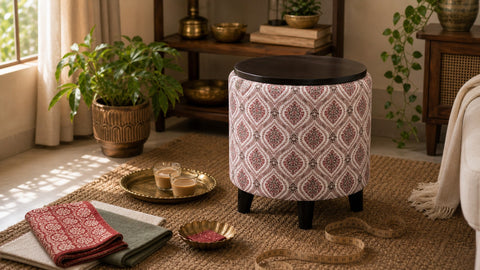
This is where a tuffet earns its keep. A low-slung piece like our cherry-red mandala tuffet sits low enough to feel like floor seating without actually being floor seating — which matters if you have older relatives whose knees no longer agree with cross-legged sitting on tile. The mandala carving is hand-finished in our Bhilwara workshop. The colour was a deliberate choice; we'd argue most small Indian living rooms are under-coloured rather than over-coloured, because a room with limited wall space ends up needing each piece to do visual work as well as functional work. A safe beige tuffet disappears in a flat that already has beige walls and beige curtains. A cherry-red one anchors the room.
One related rule of thumb: in a small flat, the pieces with the strongest opinions about colour tend to age better than the safe neutrals. A neutral piece in a small room becomes invisible; a confident piece becomes a landmark. We wrote a related argument about handling strong colour alongside warm metals in mixing metals and wood.
The side table that quietly replaces three pieces
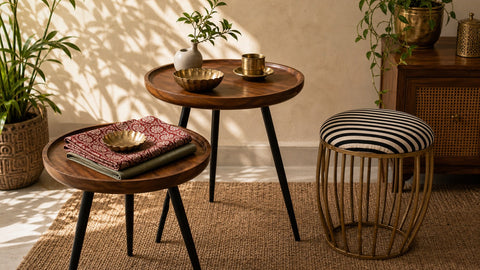
The piece most people under-buy is the small side table. In a compact Mumbai 1BHK, a well-sized side table does the work of a console (for keys and a lamp by the door), a plant stand (for the balcony basil that comes inside during monsoon), and a coffee-adjacent surface for the second person on the sofa whose chai has nowhere to go. The footprint is tiny; the utility is disproportionate.
Our walnut mango-wood side table is sized for this kind of use — small enough to slot between a 2-seater and a wall without blocking the walking line to the kitchen, sturdy enough to hold a table lamp without wobbling when someone sets a cup down. One material caveat we tell every Mumbai customer upfront: mango wood breathes with monsoon humidity. The wood will swell slightly over July and August and contract back through October. This is normal. We finish our wood with a breathable beeswax-and-oil blend rather than a sealed synthetic lacquer, specifically because the breathable finish moves with the wood instead of cracking against it. It's the kind of detail that doesn't show up in product photos but decides whether the piece survives five Mumbai monsoons or two.
What we'd actually tell someone starting from scratch
If you're furnishing a Mumbai 1BHK from zero, here's the order we'd recommend, knowing what we know from the pieces customers reorder versus the ones they quietly tuck away:
- Buy the storage ottoman first. Before the coffee table, before the second armchair, before the bookshelf. It solves the storage problem and the seating problem in one footprint, and it's the piece you'll be glad of by month three.
- Buy the side table second. Customers consistently tell us they bought it later than they should have. A small surface in the right spot disappears into the room and never leaves.
- Buy the tuffet third — once you've lived with the room enough to know where the floor-seating overflow naturally happens.
- Buy the stack-able overflow seating last, and only if you genuinely host. Most flats don't need it as often as the owners expect when they're shopping.
The pattern, across everything we hear from customers in Mumbai: the pieces sold on storage-plus-seating-plus-surface earn their footprint several times over. The pieces sold on "flexibility" mostly don't get moved. And the pieces with strong opinions about colour and material tend to age into the room rather than out of it, because a flat with limited wall space gives each object more visual weight than it would carry in a larger home.
A Mumbai 1BHK doesn't need clever furniture. It needs three or four pieces that have thought hard about what they're for. If you're staring at an empty flat and deciding where to start, start with the piece that does the most jobs from the least floor — and build outward from there.