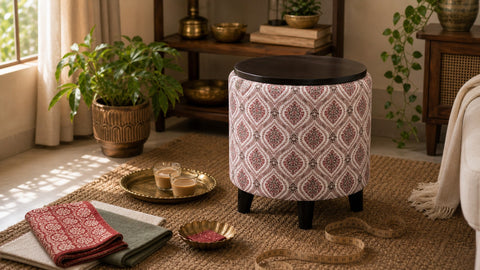
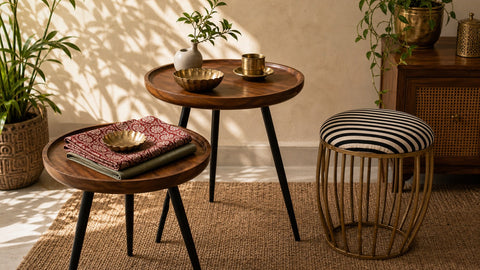
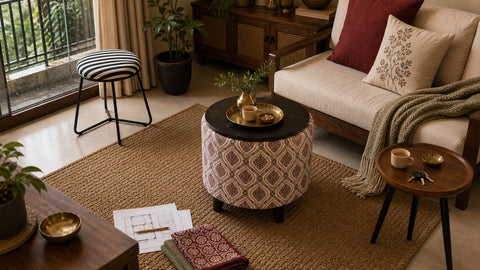
If you're considering a metal stool for your home — Greetwood or otherwise — there's a question worth asking before you buy: was the frame bent by hand, or by machine? Most furniture brands don't tell you, and most customers don't think to ask. But it's the single decision that determines how the stool will look in five years, how it will feel under you, and how much of what you're paying actually went into making it.
This piece is our argument for hand-bent frames, written for someone deciding between metal-stool options. It's also an explainer of how we make ours in Bhilwara, and why we chose that path over the cheaper, faster machine route.
Why hand-bending matters (and why most brands skip it)
A metal stool frame is essentially steel tubing bent into a shape and welded at the joins. There are two ways to do this. CNC machines bend tubing to digital specifications — fast, consistent, and cheap at scale. Hand-bending uses a jig and a craftsperson's eye — slower, more variable, and considerably more expensive per piece.
Almost every metal stool sold in India under ₹2,000 is CNC-bent. The price point requires it. Hand-bending becomes economically viable around ₹2,500–₹3,000 per piece, which is where our Cage stool sits. We charge that not because we want to, but because the labour cost of the alternative is real.
The trade-off is visible if you look. CNC-bent frames are mathematically identical — line ten of them up and they're indistinguishable. Hand-bent frames carry a slight variation: a 2mm difference in curve depth, a marginally different angle at the join. In a furniture showroom this can look like a quality problem. In a real living room, two years in, it's the reason your stool doesn't read as mass-produced. The variation is what separates "furniture you own" from "furniture that came in a flat-pack box."
The Bhilwara decision
People assume metal furniture is made in Moradabad or Jodhpur — and a lot of it is. We chose Bhilwara, a textile town in central Rajasthan, for one specific reason: every cushion on every Greetwood stool is hand-stitched, and the upholstery families we work with are based here.
This sounds like a small operational detail. It isn't. When the frame is made hand-built and the cushion is also made hand-built, the two have to be coordinated. CAD-perfect frames don't mate cleanly with hand-cut cushions — the tolerances don't match, and the gap shows. By keeping both processes in the same town, we cut the prototyping loop from weeks to days. When we redesign a cushion height, we can do it in a single visit between the workshop and the upholstery unit, in an afternoon. In a city, that round-trip would take weeks.
The other reason Bhilwara: it's where we live. When you're designing furniture for the first time, being close enough to the workshop to walk in unannounced changes what you can build. We did most of the early prototyping for the Cage stool and the Hexa stool by sitting in the workshop for entire afternoons and adjusting in real time. That iteration speed is most of why our early pieces work.
What "powder-coated" actually means (and what to look for)
Almost every metal stool you'll see is described as "powder-coated." That phrase covers a wide quality range, and as a buyer it's worth knowing the difference.
Powder coating is a four-step process: degrease, phosphate primer, base coat, topcoat. Done correctly, it produces a finish that resists scratches, humidity, and rust for a decade. Done cheaply, brands skip the phosphate primer step or apply a single thin coat — and within 18 months in a humid Mumbai or Chennai climate, you'll see micro-pitting along the welds where moisture has crept under the coating.
What to ask before buying any metal stool (from anyone):
- How many coats? Single coat is the cheap default; three is the minimum for monsoon-climate longevity; four is what we use on gold finishes because gold is unforgiving to imperfections.
- Was the primer applied? A phosphate-primer step is the difference between a stool that lasts five years and one that lasts fifteen.
- Are the welds ground flush before coating? If they aren't, the coating will pool at the join and crack within two years.
Most brands won't have answers. Treat that as data.
Why we don't sand the underside
If you flip a Greetwood metal stool upside-down, you'll see something many brands hide: the underside is finished but not polished. Weld beads are visible. The powder coating extends fully, but the surface levelling is rougher than the top.
This is a deliberate choice we've kept consistent across two years of production. Polishing the underside to a showroom finish would add real labour cost — meaningful on a ₹2,600 piece — and the customer would never see it once the stool is in their living room. More importantly, the unpolished underside is honest. It tells you where the human work happened, and it shows you that what's on top is genuinely the surface we cared about.
Showroom-finished undersides are a tell of brands that prioritise the photograph over the customer's actual experience. We'd rather you sit on a stool that looks great where you sit and is honest where you don't.
What changes (and what doesn't) over five years
Here's the honest answer most furniture brands won't give you: a powder-coated metal stool kept indoors and wiped down with a dry cloth will look essentially the same in five years as it does the day it ships. There's no patina, no character development. That's the trade-off you accept when you choose metal over wood — if you want a piece that ages visibly, that's a wood-furniture decision, and we wrote about what happens to mango wood over time separately.
The cushion, however, is a different story. Hand-stitched cotton upholstery softens with use, takes the imprint of how you sit. By around 18 months of daily use, the seating surface develops a slight sheen. Some people love this; some replace the cushion (we sell cushions separately for our stools). Neither response is wrong — but you should know going in so the choice is conscious.
So which one should you buy
If you've read this far, you're probably comparing options. A quick framework:
- The Cage stool — most versatile silhouette. Works in a Mumbai 1BHK as an extra seat, works in a larger home as an accent. Sold as a single (₹2,600) or a set of two (₹5,000). Buy the set if you have any kind of regular hosting.
- The Hexa stool — geometrically heavier visual presence. Pairs well with wooden furniture; harder to make disappear in a small room. Good for anchoring an empty corner.
- The Cross-Leg stool — the slimmest profile, the least floor footprint. Best if you want a metal accent piece without it dominating the room.
If you're new to metal furniture and don't know which silhouette will fit your home, the Cage stool single is the lowest-regret first purchase. It's the one our customers most often re-order from in a second variant once they've lived with the first.
And whichever you pick: when you sit on it, you're sitting on a hand-bent frame, a hand-welded join, and a hand-stitched cushion. That's most of the price. Now you know what you're paying for.