The hardest part of choosing a handcrafted gift is not finding something beautiful. It is deciding how much of another household we are entitled to choose for them. A large decorative object may express generosity and still leave its recipient searching for a place to keep it. A practical object may be used every day but feel too impersonal for a wedding or griha pravesh.
Our approach to Indian gifting begins with a different question: how confidently can we predict the gift’s role in the recipient’s home? The answer matters more than the occasion printed on the card. This gifting guide is built around four decisions—use, footprint, visual commitment, and care—so that a housewarming, wedding, Diwali gift, or gift for a difficult-to-buy-for person can be considered with the same clear framework.
Start with certainty, not the size of the occasion
We divide gifts into three levels of certainty. At the first level, we know a routine: the recipient cooks often, hosts tea, maintains a pooja corner, or prefers floor seating. At the second, we know the home but not every routine: perhaps we have seen the kitchen, noticed the furniture palette, or know that storage is tight. At the third, we know very little beyond the occasion.
The less we know, the less spatial and stylistic authority we should claim. This is our contrarian view: an important occasion does not automatically justify a larger gift. A substantial side table can be exactly right when we know the room; without that knowledge, its footprint and finish turn generosity into a furniture decision made on someone else’s behalf.
For low-certainty gifting, contained utility is safer than open-ended décor. A masala box has a defined job and a defined place. A compact chowki can support a known ritual or seating habit. A side table asks the recipient to reorganise a room. None is universally better; each simply requires a different amount of knowledge.
This distinction is useful for the person who “already has everything.” They usually do not need another category of possession. They may, however, appreciate a more considered version of an object already embedded in daily life. We look for replacement value rather than novelty: an object that can take over a familiar task without requiring a new habit.
For a housewarming, choose the first routine the home will need
A griha pravesh gift often arrives before the household has settled into itself. Cartons are still being opened; shelves do not yet have fixed purposes; guests may be moving between the kitchen and living room. This is why we prefer gifts that help establish a routine over pieces that dictate a finished aesthetic.
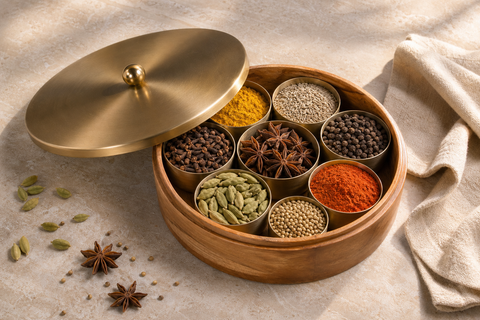
If the recipient cooks and we are confident about that routine, a kitchen object is unusually well suited to a new home. The brass-lid wooden masala box is nine inches in diameter and 2.7 inches high. Its mango-wood base holds seven stainless-steel spice jars of approximately 50–80 ml each and includes a wooden spoon. Those specifications tell us more than the word “handcrafted” alone: it needs a clear nine-inch circle on a shelf or counter, it is intended for a working spice system, and its wooden base should be wiped rather than put in a dishwasher.
That makes it a good gift only when those conditions fit. Someone who keeps spices in large labelled jars may not want to decant them. Someone with a compact kitchen may value the contained footprint; someone with almost no counter space may not. Asking one discreet question—“Do they keep a masala dabba?”—is more useful than browsing twenty housewarming lists.
For a recipient whose rituals we know better than their kitchen, the grey hand-caned Sheesham chowki offers another kind of specificity. It measures 12 by 12 inches and stands 11 inches high, arrives assembled, and is rated for up to 80 kg. The compact square is relevant for a pooja or meditation corner and for homes where flexible low seating is genuinely used. It is not a neutral “ethnic accent,” and we should not treat it as one. It is a functional piece whose value depends on an actual floor-level routine.
For weddings, gift for two people without guessing their taste
Wedding gifts carry an extra difficulty: they enter a home being negotiated by two people, sometimes alongside objects from two existing households. Matching someone’s individual taste is not enough. We need to consider whether the object can belong to a shared routine.
Coordinated kitchen pieces can work here because their relationship is functional rather than merely decorative. The Rasoi Brass Duo combines a mango-wood masala box with seven stainless-steel jars and a wooden spoon, and a mango-wood chapati box that holds approximately eight to ten rotis. Both are listed at about nine inches in diameter and 2.7 inches high. The chapati box is specified to retain warmth for roughly 30–45 minutes. The shared brass-finish lids give the pair a visual connection, while each piece still has a distinct job.
The important wedding-gift decision is not “set or single?” It is whether the couple has the routine and room for the whole set. Two nine-inch pieces need more storage than one, and neither should be chosen merely because paired objects seem symbolically appropriate. If we know they cook regularly or are setting up a kitchen from the beginning, the pairing makes sense. If they are moving between cities, living with family temporarily, or have not settled on a home, a smaller gift is more respectful.
We also avoid treating “handcrafted” as permission to guess at a couple’s décor. Preeti and Jainav founded Greetwood in Bhilwara in 2023 after designing furniture for their own home; that maker’s perspective keeps bringing us back to fit. Material character matters, but the object still has to survive the unglamorous questions: where will it sit, what will it hold, and how will it be cleaned?
For Diwali, decide between ritual colour and year-round quiet
Festival gifting creates pressure to choose the object that looks most celebratory on the day. We think that is the wrong time horizon. Diwali is the moment of giving, not necessarily the object’s only context. The stronger gift can take part in festive hosting and remain useful on an ordinary Tuesday.
Colour is therefore a decision, not a shortcut. A red floral kitchen piece has presence and can suit a home where pattern and warm colour are already welcome. A brass finish over warm wood is easier to place in many kitchens, but it is still a visible finish, not a universal neutral. A gunmetal lid is quieter and may suit a recipient who avoids bright metallic accents. We should choose among them based on evidence from the home—not on an assumption that every festival gift should be red or gold.
The red-print brass-lid chapati box is a useful example of how to test a festive object beyond appearance. It is 9 inches in diameter and 2.7 inches high, has a mango-wood base with food-grade lacquer, and holds approximately eight to ten chapatis. The documented care instruction is wipe-clean only. If the recipient regularly serves rotis at the table, it has a clear role after Diwali. If not, its festive colour cannot manufacture one.
For hosts, a serving object may be more flexible than specialised storage. The Rasoi Brass Set includes a 15-by-12-by-2.5-inch acacia-wood tray with carved inbuilt handles alongside the brass-lid masala and chapati boxes. That combination is appropriate when we know the kitchen and hosting pattern well. It is too assertive when we do not: three pieces multiply both utility and storage demand.
For difficult recipients, use the four-question test
When we cannot read someone’s taste—or when they buy exactly what they want—the occasion gives us less guidance, not more. We use four questions in order.
- Can we name the job? “For serving rotis,” “for the pooja corner,” or “beside the reading chair” is stronger than “for the home.” If the job cannot be named, the gift is probably décor disguised as utility.
- Can we name the footprint? Check the actual dimensions against a plausible surface. Nine inches across is compact, but it is not zero space. A 12-inch chowki occupies floor area even when it is visually light.
- Can we predict the care? Food-grade lacquer does not make a wooden object dishwasher-safe. Stainless-steel spice jars may be hand washed, while the wooden base should be kept dry. A gift with an incompatible care routine will quietly stop being used.
- Can we defend the finish? Red floral print, brass, gunmetal, grey cane, and walnut are choices with visual consequences. If we cannot explain why one belongs in the recipient’s home, we should reduce the visual commitment.
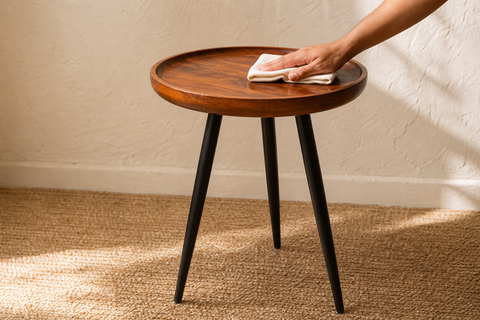
A small furniture piece belongs at the high-certainty end of this test. The walnut small mango-wood and metal side table, for example, should be chosen because we know there is a side-table job and a compatible room—not because furniture appears more generous than a kitchen object. Utility does not rise with physical size. It rises with fit.
There is also a useful stopping rule: if two of the four answers are guesses, we should not choose the object. We can ask the family, move to something with a smaller footprint and clearer function, or choose outside the home category altogether. Restraint is not a failure of imagination. It is what prevents a handcrafted piece from becoming someone else’s storage problem.
A lasting gift earns its place before it enters the home
We make and choose objects in Bhilwara, but the final test happens in another person’s kitchen, living room, or pooja corner. The occasion may shape the gesture; the recipient’s routines should shape the object.
For a housewarming, begin with the routine the new home needs. For a wedding, look for shared use without overcommitting the couple’s taste. For Diwali, choose something that still makes sense after the diyas are packed away. And for the person who is difficult to buy for, do not search harder for novelty—demand better evidence of fit. The most considerate handcrafted gift is not the one that says the most about the giver. It is the one that asks the least accommodation from the home receiving it.